
Studying in Japan is a dream for many Indian students who want to experience world-class education, advanced technology, and a rich cultural environment. Japan is known for its high academic standards, safe lifestyle, and strong career opportunities, making it an attractive destination for international students. From globally recognised universities to specialised language schools, students have multiple options to build a successful future.
However, before starting your journey, it is very important to understand how to get a visa for studying in Japan. The visa process involves several steps, including getting admission, applying for a Certificate of Eligibility (COE), preparing documents, and submitting your application correctly. Many students feel confused at the beginning, but with proper guidance, the process becomes simple and manageable.
This detailed guide will help you understand each step clearly in easy language, especially for Indian students planning to study in Japan. How to Get Admission for Studying in Japan
What is a Japanese student visa?
A Japanese student visa allows international students to study legally in Japan at universities, language schools, or vocational colleges. It comes under the “Student” residence status.
Duration of Stay
- 6 months to 2 years (renewable)
- Maximum stay: up to 4 years and 3 months
Students can also extend their visa if their course continues.
How to Get a Visa for Studying in Japan from India
If you are planning to study in Japan from India, the process is straightforward if you follow each step carefully. Here’s a clear, step-by-step guide to help you understand everything in simple terms. Japan Student Visa New Rules
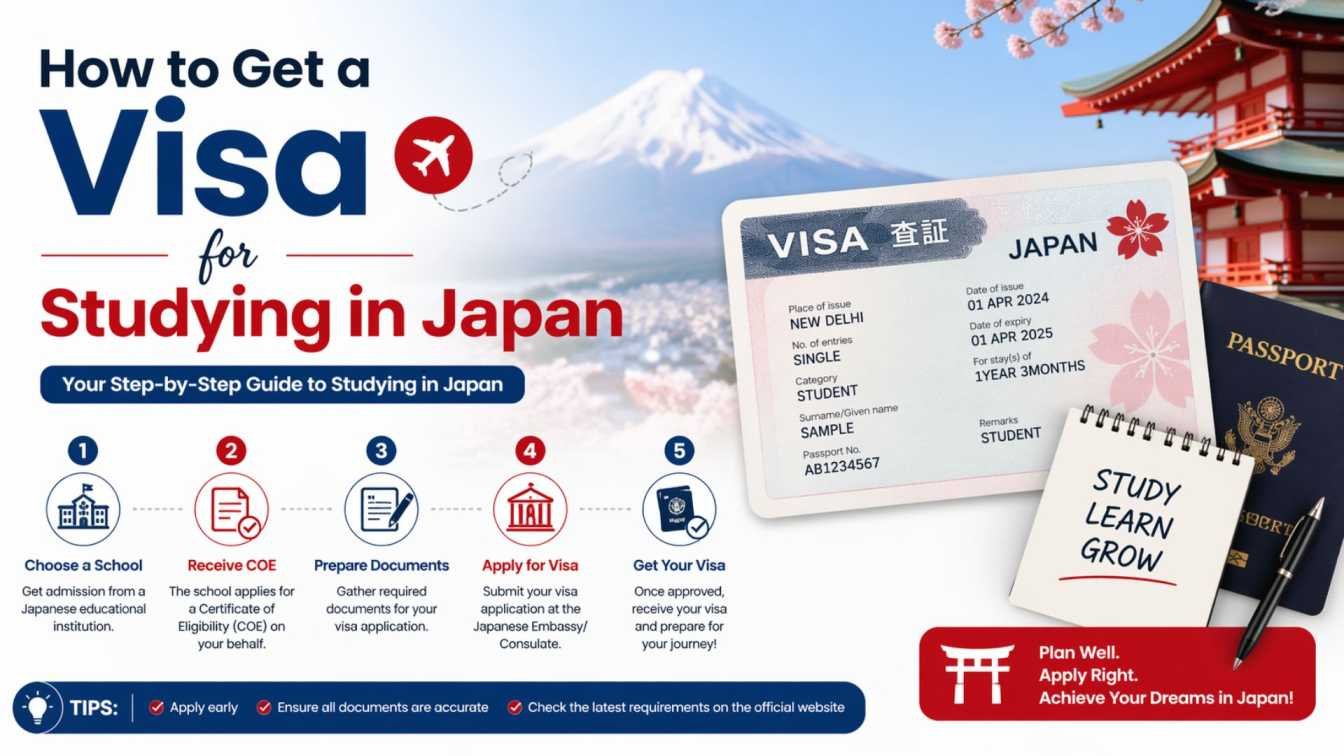
Step 1 – Get Admission in Japan
The first step is to secure admission to a recognised Japanese institution. This can be a university, Japanese language school, or vocational college. Many Indian students start with language schools because they are easier to enter and help build a strong foundation in Japanese before moving to higher education.
Step 2 – Apply for Certificate of Eligibility (COE)
The Certificate of Eligibility (COE) is the most important document for your visa.
- Your school in Japan applies for the COE on your behalf
- It is issued by the Immigration Bureau in Japan
- Processing time usually takes 1 to 3 months
The COE confirms that you are a genuine student and have sufficient financial support to live and study in Japan.
Students planning to study in Japan should first understand the complete MEXT Scholarship 2027 application process, including timelines, documents, and selection steps.
Step 3 – Prepare Required Documents
Once your COE is issued, you need to prepare all the necessary documents for your visa application.
These include:
- Valid passport
- Japan student visa application form
- Recent passport-size photographs
- Certificate of Eligibility (COE)
- Admission letter from your school
- Academic certificates (10th, 12th, graduation if applicable)
- Bank statements and financial proof
- Sponsor letter (if someone else is funding your studies)
Make sure all documents are accurate and properly organised to avoid delays or rejection.
Read More -: JLPT N2 Work Visa
What Is Golden Week in Japan
NAT Exam Dates in Japan 2026
MEXT Scholarship 2027 Application Process
Japan Student Visa Work Hours Limit 2026
Step 4 – Submit Visa Application
Submit your complete application to the Japanese Embassy or Consulate in India. In most cases, applications are submitted through authorized visa centers. Ensure that all documents match the information in your COE.
Step 5 – Visa Processing
After submission, your visa will be processed. The processing time is usually quick.
- Average time: 5 to 10 working days
If everything is correct, approval is generally smooth.
Step 6 – Travel to Japan
Once your visa is approved, you can travel to Japan.
After arriving:
- You will receive a Residence Card (Zairyu Card) at the airport
- You must register your address at your local municipal office within 14 days
This completes your legal process to stay and study in Japan.
Choosing the right institution is equally important, and students can explore the best universities in Japan for Indian students to find suitable academic and career opportunities
Japan Student Visa Requirements
Japan student visa requires valid passport, COE, admission proof, financial stability, academic records, and language proficiency to study in Japan. How to Apply for Japan Student Visa
Academic Requirements
To study in Japan, your academic background must match your chosen course. For Japanese language schools, you should have completed at least your 12th standard from a recognized board. For university programs, undergraduate courses require 12th completion, while postgraduate courses require a bachelor’s degree. A consistent academic record and minimal study gaps can improve your chances of visa approval.
Financial Requirements
Financial proof is one of the most critical parts of your visa application.
How much bank balance is required for a Japanese student visa?
You should maintain a minimum balance of ₹10–15 lakh. However, having ₹15–20 lakh is strongly recommended to increase approval chances. This amount shows that you can manage tuition fees, accommodation, food, and other living expenses during your stay in Japan. Along with bank statements, you may also need to provide your sponsor’s income proof and financial documents.
Language Requirements
Language skills depend on your course type. For language schools, basic Japanese proficiency such as JLPT N5 or N4 is preferred. For English-taught programs, you may need proof of English proficiency like IELTS. Knowing basic Japanese also helps you adjust to daily life and part-time jobs more easily. Japan Student Visa
Japan Student Visa Cost
The cost of applying for a Japan student visa from India is quite affordable.
- Visa fee: ₹500–₹1500
- Service charges: ₹500–₹2000
Total estimated cost: ₹2000 to ₹5000
Keep in mind that this fee only covers the visa application. Your main expenses will include tuition fees, accommodation, and living costs in Japan.
While studying, international students must also be aware of the Japan student visa work hours limit 2026, which defines how many hours they can legally work part-time.
How Long Does It Take to Get a Student Visa for Japan?
The visa process requires proper planning and patience.
- Admission process: 1–2 months
- Certificate of Eligibility (COE): 1–3 months
- Visa processing: 5–10 working days
Total time required: 2 to 4 months
Applying early is always recommended to avoid delays, especially during peak intake periods.
Student Visa Japan Age Limit
There is no official age limit for applying for a student visa. However, most applicants fall within the 18–30 age group. If you are older, you need to provide a strong reason for studying in Japan, such as career advancement, skill development, or a clear professional goal. A well-written study plan is crucial in such cases.
Study Options in Japan
Japan offers multiple education pathways depending on your career goals.
Language Schools
These are ideal for beginners who want to learn Japanese. Courses typically last from 6 months to 2 years and are a popular choice among Indian students.
Universities
Japanese universities offer undergraduate, postgraduate, and research programs. Many universities also provide English-taught courses for international students.
Vocational Colleges
These institutions focus on practical skills such as IT, business, hospitality, and animation. They are perfect for students looking for job-oriented training.
For Indian applicants, it is essential to understand the complete Japan visa for Indians process, including requirements, documents, and approval stages
Living Cost in Japan
Living expenses in Japan vary depending on the city, but here’s an average monthly estimate:
- Rent: ₹30,000 – ₹60,000
- Food: ₹15,000 – ₹25,000
- Transport: ₹5,000 – ₹10,000
Total monthly cost: ₹60,000 – ₹1,00,000
Major cities like Tokyo are more expensive, while smaller cities are more budget-friendly for students.
Part-Time Work in Japan
International students are allowed to work part-time while studying.
- Up to 28 hours per week during academic sessions
- Full-time during holidays
Average monthly earnings: ₹60,000 – ₹100,000
Part-time jobs help students manage their expenses and gain valuable work experience.
Common Reasons for Visa Rejection
Although Japan has a high visa approval rate, applications may get rejected due to:
- Low or insufficient bank balance
- Incomplete or incorrect documentation
- Weak academic background
- Lack of a clear study plan or career direction
Avoiding these mistakes can significantly improve your chances of approval.
Tips to Increase Visa Approval Chances
Maintain strong finances, submit accurate documents, choose recognized institutions, show clear study goals, avoid gaps, and ensure genuine intent to study in Japan.
- Maintain strong and consistent financial proof
- Apply through recognised and reputed institutions
- Double-check all documents before submission
- Clearly explain your purpose of study and future goals
- Show genuine intent to study and return if required
Following these tips can make your Japan student visa process smooth and successful.
FAQs – Japan Student Visa (2026)
1. Is it easy to get a student visa for Japan?
Yes, getting a student visa for Japan is relatively easy compared to many other countries, especially if your documents are complete and genuine. The most important factors are a valid Certificate of Eligibility (COE), strong financial proof, and a clear study plan. Japan has a structured visa process, and if you meet all requirements, your chances of approval are quite high. Most Indian students get their visas without major issues.
2. Do I need a visa to study in Japan?
Yes, if you are an Indian student or any international student, you must apply for a student visa to study in Japan. Even if your course is short-term, a visa is usually required unless your country has a visa exemption agreement. For long-term programs like language schools, universities, or vocational courses, a student visa is mandatory.
3. How much money is required for a student visa in Japan?
To apply for a Japan student visa, you need to show proof of financial stability. Typically, you must have at least ₹10–15 lakh in your bank account. This amount demonstrates that you can cover tuition fees, accommodation, food, and other living expenses in Japan. Some institutions may ask for even higher funds depending on the course duration.
4. Is 2 lakh enough for Japan?
No, ₹2 lakh is not enough to get a student visa for Japan. Immigration authorities require proof that you can support yourself for at least one year. Since Japan’s living cost is relatively high, a minimum balance of ₹10 lakh or more is expected. Having insufficient funds is one of the most common reasons for visa rejection.
5. Is Japan bringing in 50,000 Indians?
Japan has been actively encouraging skilled workers and international students, including those from India. While there is growing collaboration between India and Japan, there is no officially confirmed fixed number like 50,000. However, the number of Indian students in Japan is steadily increasing due to better job opportunities and friendly visa policies.
6. What is the Japan visa rejection rate?
Japan has a relatively low visa rejection rate compared to countries like the USA or UK. If your documents are accurate, your financial proof is strong, and your purpose of study is clear, approval chances are high. Most rejections happen due to incomplete paperwork, fake documents, or weak financial background.
7. How much is a 1 year student visa?
The visa fee for a Japan student visa is quite affordable, usually ranging from ₹500 to ₹1500. However, this fee only covers the visa application. You should also consider tuition fees, accommodation costs, and daily expenses, which make up the majority of your overall budget for studying in Japan.
8. Can I move to Japan without a job?
Yes, you can move to Japan as a student without having a job offer. A student visa allows you to enter Japan for educational purposes. After arrival, you are allowed to work part-time (up to 28 hours per week), which helps you manage your expenses while studying.
9. Does Japan give a 5-year visa?
Japan does not usually provide a 5-year student visa. Student visas are issued based on your course duration and are typically valid for 6 months to 2 years at a time. However, you can extend your visa if your course continues. Long-term visas (like 5 years) are usually given for work or permanent residency, not student status.
10. Can I study in Japan for 3 months?
Yes, you can study in Japan for a short duration of 3 months. In such cases, you may apply for a short-term or temporary visitor visa instead of a student visa. However, short-term visas usually do not allow part-time work, so they are best suited for language courses or short academic programs.
Conclusion
Understanding how to get a visa for studying in Japan is the first step toward building a successful international career. The process may seem lengthy, but it becomes simple when you follow each step carefully.
For Indian students, Japan offers high-quality education, affordable tuition compared to Western countries, part-time work opportunities, and strong career prospects.
Plan early, maintain proper financial proof, and choose the right course. With the right preparation and guidance, your dream to study in Japan can become a reality.